

Plenty of cars in India now advertise paddle shifters, and most “cars with paddle shifters” lists just dump them all together with a price. That misses the one thing that actually matters: paddle shifters are only as good as the gearbox behind them. The same pair of paddles can feel sharp and fun on one car and pointless on another. So this guide ranks them by how good the paddles really are, not just by who fits them.
The quick version: for genuinely engaging paddles you want a dual-clutch (DCT/DSG) automatic. On a budget AMT, paddles are mostly a novelty. And on an EV, the paddles do something different entirely.
Prices are ex-showroom and approximate for 2026, and the variant where paddles first appear; confirm the latest figure at the dealer.
Quick answer
- Cheapest car with real, responsive paddles: Hyundai i20 N Line (7-speed DCT), from about ₹11.2 lakh.
- Cheapest car with paddle shifters of any kind: Hyundai Exter (5-speed AMT), from about ₹8.9 lakh, but the paddles are a gimmick on an AMT.
- Most fun paddles for the money: the Volkswagen and Skoda TSI cars (Virtus, Taigun, Slavia, Kushaq) with their DSG dual-clutch boxes.
- Best in an EV: Tata Punch EV and Nexon EV, where the paddles adjust regenerative braking rather than gears.
The thing nobody tells you: it is all about the gearbox
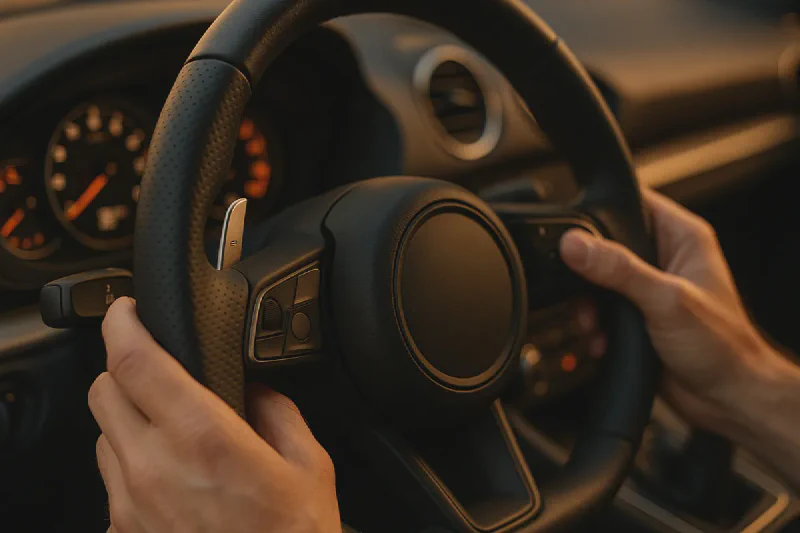
A paddle shifter is just a switch on the steering wheel. Pull it and it asks the gearbox to change gear. How good that feels depends entirely on the type of automatic underneath. Here is the honest order, best to worst, for how satisfying the paddles are to use.
- Dual-clutch (DCT / DSG): the real deal. Two clutches pre-select the next gear, so shifts are near-instant and crisp. This is where paddles genuinely add fun. Found on Hyundai and Kia turbo cars (i20 N Line, Venue, Sonet, Creta, Seltos) and the Volkswagen and Skoda TSI range.
- Torque-converter automatic (AT): good enough. The traditional smooth automatic. Paddle response is fine for everyday overtakes and engine braking, just not razor-sharp. This is most Maruti and Toyota automatics (Brezza, Fronx, Ertiga, Hyryder).
- CVT: smooth but synthetic. A CVT has no real gears, so paddles call up simulated “steps”. It works, but the rubber-band feel takes the edge off. Honda’s automatics (Amaze, Elevate) sit here.
- AMT: largely a gimmick. An AMT is a manual with a robot working the clutch. It shifts slowly and with a noticeable pause, so paddles give you control but not speed or smoothness. Fine to have, but do not buy a car for its AMT paddles.

How paddle shifters work
The right paddle (marked +) shifts up, the left (marked −) shifts down. Pulling one sends an electronic signal to the transmission control unit, which makes the change while protecting the engine from over-revving or stalling. In most cars you can tap the paddles any time for a quick manual override, and the gearbox slips back to full automatic after a while. They are genuinely useful for confident overtakes, holding a gear on a ghat road, and engine braking on long descents.
Cars with paddle shifters in India, by gearbox
Dual-clutch (DCT/DSG): the ones worth having
- Hyundai i20 N Line (7-speed DCT), from about ₹11.2 lakh. The cheapest way into genuinely sharp paddle shifts, in a warm-hatch package that suits them.
- Hyundai Venue and Kia Sonet (7-speed DCT), from about ₹12 lakh. Compact SUVs whose turbo-DCT combo makes the paddles fun rather than for show.
- Skoda Kushaq and Slavia, Volkswagen Taigun and Virtus (TSI with DSG), from about ₹13 to 16 lakh. The enthusiast’s pick. The 1.0 and 1.5 TSI turbo engines with the quick DSG are the most engaging paddle setups at this price.
- Hyundai Creta and Kia Seltos (7-speed DCT), from about ₹15 lakh in DCT form. Mainstream SUVs that also offer the responsive dual-clutch box higher up the range.
Torque-converter automatics (AT): perfectly good
- Maruti Brezza, Fronx and Ertiga (6-speed AT), from about ₹11 to 12 lakh. Smooth, dependable automatics with paddles that do the job without thrilling you.
- Toyota Taisor and Urban Cruiser Hyryder, similar story, with the Hyryder adding strong hybrid efficiency.
CVT: smooth, less involving
- Honda Amaze and Elevate (CVT), from about ₹9.2 lakh for the Amaze. Relaxed and easy, with paddles that summon simulated ratios. Comfortable rather than sporty.
AMT: paddles, but a gimmick
- Hyundai Exter (5-speed AMT), from about ₹8.9 lakh, the cheapest car with paddle shifters in India. Also the Tata Nexon in AMT form. The paddles work, but the slow AMT shifts mean you will rarely bother. Buy these cars for their other strengths, not the paddles.
EVs: paddles for regen, not gears
- Tata Punch EV and Nexon EV, from about ₹10 to 12.5 lakh. EVs have a single-speed gearbox, so the paddles here adjust regenerative braking levels instead of changing gear. That is genuinely useful, letting you dial up regen for near one-pedal driving in traffic, but it is a different feature from a sporty manual override.
At a glance
Approximate ex-showroom starting prices for the paddle-equipped variant; verify locally.
| Car | From | Gearbox | Are the paddles worth it? |
|---|---|---|---|
| Hyundai Exter | ₹8.9 lakh | 5-speed AMT | Gimmick |
| Honda Amaze | ₹9.2 lakh | CVT | Smooth, not sporty |
| Tata Nexon (AMT) | ₹9.6 lakh | AMT | Gimmick |
| Tata Punch EV | ₹10 lakh | EV (regen) | Useful, but for regen |
| Hyundai i20 N Line | ₹11.2 lakh | 7-speed DCT | Yes, genuinely fun |
| Maruti Brezza / Fronx / Ertiga | ₹11 lakh | 6-speed AT | Decent |
| Hyundai Venue / Kia Sonet | ₹12 lakh | 7-speed DCT | Yes |
| Skoda Kushaq/Slavia, VW Taigun/Virtus | ₹13 lakh | TSI DSG | Best in class |
| Hyundai Creta / Kia Seltos | ₹15 lakh | 7-speed DCT | Yes |
To work out the on-road price for your city, our road tax calculator will get you close.
Do you actually need paddle shifters?
Honestly, for pure city commuting, not really. A good automatic in full auto mode handles traffic better than you flicking paddles. Where they earn their keep is on a twisty hill road, for a planned overtake, or for engine braking on a long downhill, and that is far more rewarding with a quick dual-clutch box than a slow AMT. So treat paddles as a nice-to-have that is only worth chasing on a DCT or DSG car. If your shortlist is AMT-only, spend your money on safety and features instead, which is exactly what our safest cars in India guide and best SUVs under ₹10 lakh focus on.
Cars with paddle shifters: FAQs
Which is the cheapest car with paddle shifters in India? The Hyundai Exter, from around ₹8.9 lakh ex-showroom, though its paddles work through a slow 5-speed AMT, so they are more novelty than performance feature.
Which cheap car has the best paddle shifters? The Hyundai i20 N Line, from about ₹11.2 lakh, is the most affordable car with a quick dual-clutch (DCT) gearbox, which is what makes paddles genuinely responsive.
Are AMT paddle shifters any good? Not really. An AMT shifts slowly with a clear pause between gears, so the paddles give you control but not speed or smoothness. For an engaging experience, look for a DCT, DSG or at least a torque-converter automatic.
Do paddle shifters work on electric cars? Yes, but differently. EVs have a single-speed transmission, so cars like the Tata Punch EV and Nexon EV use the paddles to adjust regenerative braking strength rather than to change gear.
Are paddle shifters worth it for city driving? For everyday city traffic, a normal automatic is easier. Paddles are most useful on hilly roads, for overtakes and for engine braking, and they are far more satisfying on a dual-clutch car than an AMT.
The bottom line
Paddle shifters are only as good as the gearbox they are bolted to. If you want them to be fun, buy a dual-clutch car: the Hyundai i20 N Line is the cheapest genuinely engaging option, and the Volkswagen and Skoda TSI cars are the enthusiast’s choice. Treat paddles on an AMT as a box-ticking feature rather than a reason to buy, and remember that on an EV they are really a regen control. Choose the gearbox first, and the paddles will look after themselves.