

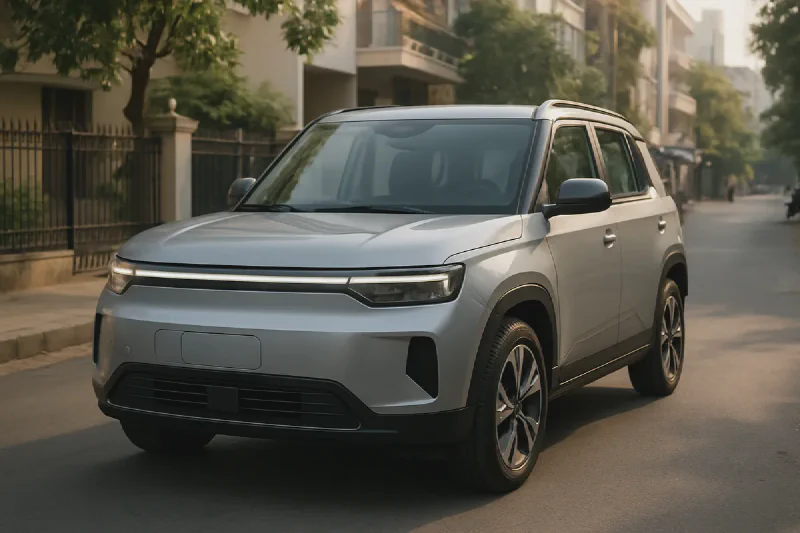
Kia launches the Syros EV around 23 July 2026, and bookings are already open at a ₹25,000 token. This is Kia’s most affordable electric car in India, a compact, tall-boy electric SUV that slots in below the Carens Clavis EV. For anyone shopping a first EV around ₹15 lakh, this is one of the most important launches of the year.
This guide gives you what actually matters before you book: the expected price, the real on-road cost, how far it genuinely goes on a charge, whether it is cheaper to run than a petrol car, which variant to pick, and a straight verdict on whether to buy it now or wait. Final prices land on launch day, so some figures below are still “expected” and flagged as such.
Prices are ex-showroom estimates and change with variant, city and offers. Confirm the on-road price at a Kia dealer before you book.
At a glance
- Launch: expected 23 July 2026. Bookings open now at ₹25,000.
- Expected price: around ₹13 lakh to 18 lakh ex-showroom, across the range.
- Segment: sub-4-metre electric SUV. Rivals the Tata Nexon EV, MG Windsor EV and Mahindra XUV 3XO EV.
- Batteries: two packs, 42 kWh and 51.4 kWh.
- Range: up to 526 km on the bigger pack (ARAI claim), around 443 km on the smaller one.
- Charging: 100 kW DC fast charging, 10 to 80 percent in about 39 minutes.
- Safety: six airbags on every variant, with Level 2 ADAS on the top X-Line trim.
What this guide covers
- Kia Syros EV price and on-road cost
- Battery, range and charging
- Is it cheaper to run than a petrol car?
- Features and safety
- Which variant should you buy?
- Buy it now or wait? The verdict
- Kia Syros EV vs its rivals
- FAQ
Kia Syros EV price and on-road cost
Kia has not put out the final price sheet yet, that comes on launch day. Based on the booking and where the segment sits, the industry-expected range is around ₹13 lakh to 18 lakh ex-showroom, with the bigger-battery Extended Range variants near the top.
Here is the good news that most buyers miss: an EV’s on-road price is usually much closer to its ex-showroom price than a petrol car’s. Many states waive or heavily cut road tax on electric cars, and some drop registration charges too. So the ₹1.5 to 2 lakh gap you would pay on a petrol SUV shrinks to mostly just insurance on an EV, depending on your state.
| Variant level | Expected ex-showroom | Rough on-road (varies by state) |
|---|---|---|
| Base (42 kWh) | ~₹13 lakh | ~₹13.7 to 14.5 lakh |
| Mid (Extended Range) | ~₹15.5 lakh | ~₹16.3 to 17.2 lakh |
| Top X-Line (51.4 kWh) | ~₹18 lakh | ~₹19 to 20 lakh |
Road tax rules differ a lot between states, and the EV waiver is exactly why this matters. For your exact city, plug the ex-showroom figure into our Road Tax Calculator, which already accounts for the EV concession. If you are financing it, our Car Loan EMI Calculator shows the real monthly cost and total interest from the on-road price, not an abstract loan amount.
Battery, range and charging
The Syros EV comes with two battery packs, and picking the right one is the most important decision here.
| Pack | Claimed range (ARAI) | Realistic range | Best for |
|---|---|---|---|
| 42 kWh (Standard Range) | ~443 km | ~330 to 360 km | City commuting, second car |
| 51.4 kWh (Extended Range) | ~526 km | ~400 to 430 km | Occasional highway runs, only car |
Treat the ARAI figures as a lab number, not what you will see. In real Indian conditions, with AC on and mixed driving, expect roughly 75 to 80 percent of the claim. That still means the smaller pack comfortably covers a week of city driving between charges, and the bigger pack removes most range anxiety for the occasional 300 km trip.
On charging, the Syros EV supports 100 kW DC fast charging, which Kia says takes it from 10 to 80 percent in about 39 minutes at a fast charger. At home on a regular AC wall box, a full charge is an overnight job. For most owners the routine is simple: plug in at home, top up, and only think about public chargers on the rare long drive.

Is the Syros EV cheaper to run than a petrol car?
This is where an EV earns its higher sticker price back. Charging at home costs roughly ₹1.2 to 1.5 per kilometre, while a petrol compact SUV costs around ₹6 to 7 per kilometre in fuel. That is a gap of about ₹5 per km, which adds up fast.
Rough math: if you drive 1,200 km a month, the Syros EV saves you close to ₹6,000 a month over a petrol equivalent, or around ₹70,000 a year, before you count the lower servicing an EV needs. Over five years that saving alone can be ₹3.5 lakh or more, which pays back a big chunk of the price premium an EV carries over a petrol car.
But the honest catch is the same for every EV: the maths only works if you can charge at home or at work. If you would depend on public fast chargers at ₹18 to 22 per unit, your per-km cost jumps and a lot of the saving disappears.
Do not guess this for your own usage. Put your monthly kilometres and both cars’ prices into our Car Running Cost Calculator, which shows the exact rupees per km for an EV vs petrol and how long the price premium takes to pay back.
Heads up: an EV is a brilliant buy if you have home charging and drive regularly. If you live where you cannot install a charger and do low kilometres, a good petrol or CNG car may still be the smarter money buy, even though the EV looks cheaper to run on paper.
Features and safety
For a car at this price, the Syros EV is generously kitted. The headline is a 30-inch panoramic display, made of a 12.3-inch driver’s cluster and a 12.3-inch touchscreen sitting side by side, with wireless Android Auto and Apple CarPlay. Higher trims add ventilated front seats, a powered driver’s seat, a 360-degree camera and a sunroof.
On safety, Kia has been sensible: six airbags come on every single variant, along with ESC, hill-start assist and ISOFIX child-seat mounts. A Level 2 ADAS suite (adaptive cruise, lane-keep assist, autonomous emergency braking) is offered, but only on the top X-Line variant, so if driver-assist tech is a must-have for you, that decides your trim.
If safety is your top filter across the class, our roundup of the safest cars in India tracks the latest Bharat NCAP 5-star results.
Which variant should you buy?
There are five trims, from the base HTK up to the X-Line, in Standard Range and Extended Range forms. Here is how to choose without overpaying.
For most buyers, a mid Extended Range trim is the sweet spot. You get the bigger 51.4 kWh battery that removes range worry, plus the core comfort and safety kit, without paying top-trim money for the sunroof and full ADAS. This is the one to shortlist first.
Buy the base 42 kWh only if this is a pure city second car and you genuinely never do long drives. It is the cheapest way in, and 330-odd real kilometres is plenty for daily commuting. Do not stretch to it as your only car if you take highway trips.
Go to the top X-Line only if you specifically want Level 2 ADAS, since that is the trim it is locked to. If you do not care about adaptive cruise and lane-keep, the money is better kept in your pocket.
Not sure the Syros EV is even the right car for you? Our Find Your Car tool takes your budget and needs and gives you three matched picks in a minute.
Buy it now or wait? The verdict
Here is the honest call. If you want a compact EV around ₹15 lakh and you have home charging, the Syros EV is worth booking, but wait for the on-road price and the first real reviews before you pay.
The case for it is strong: two battery choices, a genuinely usable 400 km-plus real range on the bigger pack, six airbags across the board, a big-screen cabin, and Kia’s assured-buyback and long battery warranty that take some of the fear out of EV resale. Those ownership promises matter, because worry about EV resale value is the number one thing that stops buyers, and Kia is directly answering it.
The reasons to pause: Kia has not confirmed final prices, and EV launch prices sometimes come in higher than the leaks. The Level 2 ADAS being locked to the most expensive trim is a small letdown. And as with any new EV, the smart move is to wait for the first independent range and charging tests after launch rather than trust the ARAI number.
So: book it if the ex-showroom lands near ₹13 to 15 lakh and you can charge at home. Wait for reviews if you are cross-shopping the Nexon EV or MG Windsor, because a few weeks of real-world data is worth more than any spec sheet. If you cannot charge at home, look hard at a petrol or CNG SUV instead before you commit to an EV.
Kia Syros EV vs its rivals
The affordable electric SUV space is heating up fast. Quick context on where the Syros EV sits.
| Model | Starting price (approx) | Claimed range | Notable strength |
|---|---|---|---|
| Kia Syros EV | ~₹13 lakh (expected) | up to 526 km | Two batteries, tall-boy space, buyback |
| Tata Nexon EV | ~₹12.5 lakh | up to 489 km | Widest service network, proven |
| MG Windsor EV | ~₹14 lakh | up to 449 km | Battery-rental pricing, lounge seats |
| Mahindra XUV 3XO EV | ~₹13 lakh | up to 460 km | Value features, sharp looks |
The Syros EV’s real edge is the choice of two battery packs and its boxy, upright body that turns into genuine cabin and boot space, plus Kia’s assured-buyback safety net. The Nexon EV counters with the biggest service reach, and the Windsor EV with its low battery-subscription entry price. For the wider EV picture, see our upcoming electric cars in India 2026 pillar and the full upcoming cars in India 2026 hub.
FAQ
When does the Kia Syros EV launch in India? Kia is expected to launch the Syros EV around 23 July 2026. Bookings are already open at a ₹25,000 token at Kia dealerships.
What is the expected price of the Kia Syros EV? Around ₹13 lakh to 18 lakh ex-showroom, expected, with the bigger-battery Extended Range variants near the top. Because most states waive or cut road tax on EVs, the on-road price stays closer to ex-showroom than it would on a petrol car.
What is the range of the Kia Syros EV? Up to 526 km on the 51.4 kWh Extended Range pack and around 443 km on the 42 kWh pack, both ARAI claims. In real conditions expect roughly 400 to 430 km and 330 to 360 km respectively.
How long does the Kia Syros EV take to charge? With 100 kW DC fast charging, Kia claims 10 to 80 percent in about 39 minutes. On a home AC wall box, a full charge is an overnight job.
Is the Kia Syros EV cheaper to run than a petrol car? Yes, if you can charge at home. Home charging costs roughly ₹1.2 to 1.5 per km against ₹6 to 7 per km for petrol, which can save close to ₹6,000 a month at 1,200 km. The saving shrinks if you rely on public fast chargers. Use our running cost calculator to check your own break-even.