
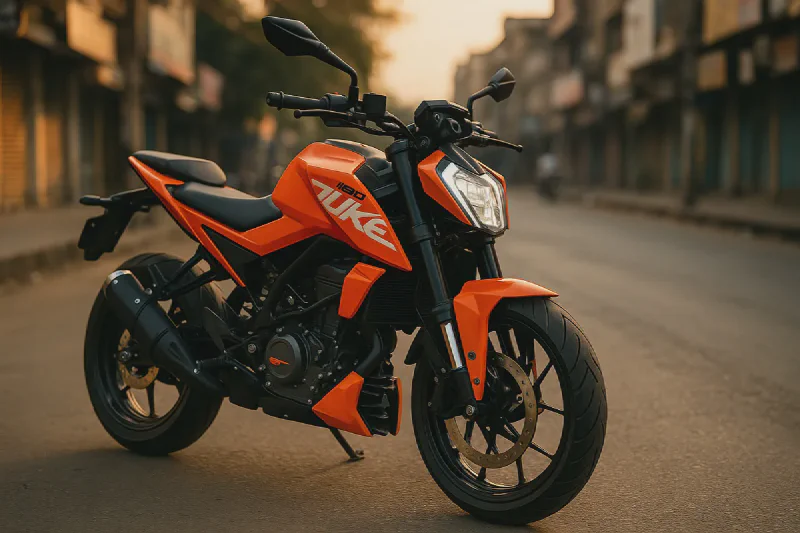
The KTM 160 Duke is the cheapest way to put a real KTM in your garage. It brings the sharp Duke look, upside-down front forks and a liquid-cooled engine to a price that sits just above the popular 160cc commuter-sports bikes. But it is not the simple “value KTM” some buyers expect. This guide gives you the real price, the full specs, the mileage you will actually see, an honest call on the LCD versus TFT variant, and a clear answer to the two questions buyers keep asking: should you get this over a TVS Apache RTR 160, and is it worth stretching to the 200 Duke instead.
The 160 Duke went on sale in India in August 2025, so this is a “should I buy it now” guide, not a launch rumour piece. Prices here are ex-showroom and change often, so confirm the on-road figure at a KTM dealer before you book. You can get a rough on-road estimate using our Road Tax Calculator.
The short answer
- Price: about ₹1.74 lakh (LCD variant) to ₹1.86 lakh (TFT variant) ex-showroom. On-road is roughly ₹2.00 to 2.15 lakh depending on your state.
- Engine: 164.2cc, liquid-cooled, single-cylinder, making 19 PS and 15.5 Nm, with a 6-speed box.
- Real mileage: roughly 35 to 40 kmpl in mixed riding (KTM’s ARAI claim is about 36.5 kmpl).
- Best variant to buy: the LCD variant. The mechanicals are identical to the TFT bike, so the cheaper one is the smart buy unless you specifically want the colour screen and built-in navigation.
- Buy it if: you want premium hardware (USD forks, liquid cooling, a trellis frame) and the KTM badge, and you will enjoy a sharp, firm, sporty ride.
- Skip it if: you mainly commute, want the lowest running cost, are under about 5 feet 5 inches (the 815mm seat is tall), or you can stretch your budget, in which case the 200 Duke is the better buy.

KTM 160 Duke price and variants
KTM sells the 160 Duke in two variants. The only real difference between them is the instrument display, so you are not paying extra for more performance, just for the screen.
| Variant | Display | Ex-showroom price (approx) |
|---|---|---|
| 160 Duke LCD | LCD cluster | ₹1.74 lakh |
| 160 Duke TFT | 5-inch colour TFT + KTM Connect navigation | ₹1.86 lakh |
On-road price adds road tax, insurance and registration, so expect roughly ₹2.00 to 2.15 lakh depending on your state. Bikes from KTM also carry higher service and parts costs than a TVS or Bajaj, which matters more than the sticker price over a few years (more on that below).
Colours are Electronic Orange, Atlantic Blue and Silver Metallic Matte.
Full specifications
| Specification | KTM 160 Duke |
|---|---|
| Engine | 164.2cc, liquid-cooled, single-cylinder |
| Power | 19 PS at 9500 rpm |
| Torque | 15.5 Nm at 7500 rpm |
| Gearbox | 6-speed |
| Mileage (ARAI) | about 36.5 kmpl |
| Real-world mileage | about 35 to 40 kmpl |
| Front suspension | WP Apex upside-down (USD) forks |
| Rear suspension | WP Apex monoshock, preload adjustable |
| Front brake | 320mm disc, radial 4-piston caliper |
| Rear brake | disc, with switchable (off-road) ABS |
| Frame | split steel trellis |
| Wheels | 17-inch alloy, tubeless tyres |
| Kerb weight | about 147 kg |
| Seat height | 815 mm |
| Ground clearance | 174 mm |
| Fuel tank | 10.1 litres |
| Lighting | full LED |
Specs and prices change, so treat these as a guide and confirm at the dealer before you buy.

What the 160 Duke gets right
This is where your extra money goes compared with a regular 160cc bike.
- Premium hardware. WP Apex upside-down front forks, a 320mm front disc with a radial caliper, a split steel trellis frame and a liquid-cooled engine are parts you normally see on bikes costing a lot more. On paper, nothing in the 160cc class matches this kit.
- Genuine Duke character. It is light at about 147 kg, the throttle is sharp, and it changes direction quickly. In the city it feels eager and fun, and it pulls cleanly off the line.
- The badge and the looks. A KTM stands out in a parking lot full of commuters. For a lot of young riders, that street presence is half the reason to buy one.
- Switchable ABS. You can turn off the rear ABS for a bit of fun on loose surfaces, which is rare at this price.
Where it falls short (the honest part)
No site that only lists specs will tell you this clearly, so here it is.
- Running cost is higher. KTM service intervals, labour and spare parts cost more than a TVS Apache or Bajaj Pulsar. Over three to four years this gap is real money, and it is the single most common regret among KTM owners on a budget.
- The seat is tall. At 815mm, riders under about 5 feet 5 inches may struggle to flat-foot at signals. Sit on one before you buy.
- The ride is firm. Sporty suspension means you feel bad roads and speed breakers more than on a softer commuter. Fine for short, fun rides, tiring on a long broken-road commute.
- Mileage is only okay. About 35 to 40 kmpl is fine for the performance, but a plain 160cc commuter will beat it, and the KTM prefers higher-priced fuel habits if you ride it hard.
- It is single-cylinder. Above 90 to 100 kmph you feel vibrations, and pillion comfort is limited. This is a city and short-highway bike, not a tourer.
KTM 160 Duke vs the rivals
For most buyers the real fight is against the cheaper 160cc sports-commuters, and against KTM’s own 200 Duke one step up.
| Bike | Approx ex-showroom price | Why you would pick it |
|---|---|---|
| KTM 160 Duke | ₹1.74 to 1.86 lakh | Premium hardware, KTM badge, sharpest handling in the class |
| TVS Apache RTR 160 4V | ₹1.20 to 1.45 lakh | Much cheaper, friendlier, lower running cost, strong everyday bike |
| Bajaj Pulsar N160 | ₹1.20 to 1.40 lakh | Value, comfort, easy and cheap to live with |
| Yamaha MT-15 V2 | around ₹1.70 lakh | Closest in price and character, smoother, very refined |
| KTM 200 Duke | around ₹1.99 lakh | A clear step up in power for not much more money |
Against the TVS Apache RTR 160 4V: the Apache is ₹30,000 to ₹50,000 cheaper, gentler to ride, cheaper to service, and a brilliant everyday bike. The KTM gives you better hardware, more outright sharpness and the badge. If you want the lowest-stress, lowest-cost option, the Apache wins. If you want the premium feel and will look after it, the KTM is the more special bike. We break the Apache range down in our TVS Apache models guide.
Against the KTM 200 Duke: this is the question that catches most buyers. The 200 Duke costs only about ₹15,000 to ₹25,000 more on-road but gives you noticeably more power and a bigger-bike feel. If you can stretch the budget and you want the performance, the 200 Duke is the better long-term buy. The 160 makes sense when the budget is firm, you want slightly easier running costs, or you are a newer rider who wants the KTM experience in a friendlier package. If you are weighing the bigger Apache too, see our TVS Apache RTR 200 4V guide.
Which variant should you buy?
Buy the LCD variant and save the money. The engine, suspension, brakes and frame are identical on both bikes. The TFT variant only adds the 5-inch colour screen and KTM Connect turn-by-turn navigation. That is nice to have, but it is not worth roughly ₹12,000 extra unless you genuinely want built-in navigation on the bike. Put that saving towards your first service, a good helmet or riding gear instead.
Who should buy the KTM 160 Duke
Buy it if:
- You want the most premium hardware and the sharpest handling in the 160cc class.
- You love the Duke looks and the KTM badge, and street presence matters to you.
- Your riding is mostly city plus the occasional fun weekend blast, and you will maintain it properly.
Look elsewhere if:
- You mainly commute long distances on bad roads and want comfort and the lowest running cost (a TVS Apache RTR 160 4V or Bajaj Pulsar N160 is the smarter buy).
- You are short and cannot flat-foot the 815mm seat comfortably.
- You can stretch your budget, in which case the 200 Duke is the better bike for the money. And if you can go well past ₹2 lakh, look at the Triumph 400 family before deciding anything.
If you are still deciding between a bike and a scooter for daily use, our guide to the best scooters under ₹1 lakh covers the cheaper, easier two-wheeler options.
Frequently asked questions
What is the on-road price of the KTM 160 Duke? Roughly ₹2.00 to 2.15 lakh depending on your state’s road tax and insurance. The LCD variant is the cheaper of the two. Use our Road Tax Calculator for a closer estimate.
What is the real mileage of the KTM 160 Duke? Expect about 35 to 40 kmpl in mixed riding. KTM’s ARAI figure is around 36.5 kmpl. Ride it hard and it drops; ride it calmly and you can touch the higher end.
Is the KTM 160 Duke good for beginners? It can work for a confident new rider, but the firm ride, tall 815mm seat and higher running cost make a TVS Apache RTR 160 4V or Bajaj Pulsar N160 an easier first bike for many people.
KTM 160 Duke or 200 Duke, which is better? If you can afford the roughly ₹15,000 to ₹25,000 jump on-road, the 200 Duke gives more power and feels like a bigger bike, so it is the better long-term buy. The 160 makes sense on a firm budget or for a newer rider.
LCD or TFT variant? Buy the LCD variant. The bikes are mechanically identical and the TFT only adds a colour screen and navigation, which most buyers do not need.
Does the KTM 160 Duke have dual-channel ABS? It has switchable ABS, including an off-road mode that lets you turn off the rear-wheel ABS. Confirm the exact setup on your variant at the dealer.